How to Draw Wwi Planes

Earth War I was the start major disharmonize involving the big-scale utilise of aircraft. Tethered observation balloons had already been employed in several wars, and would exist used extensively for artillery spotting. Germany employed Zeppelins for reconnaissance over the North Sea and Baltic and also for strategic bombing raids over Uk and the Eastern Front.
Aeroplanes were but coming into military use at the outset of the state of war. Initially, they were used mostly for reconnaissance. Pilots and engineers learned from experience, leading to the development of many specialized types, including fighters, bombers, and trench strafers.
Ace fighter pilots were portrayed as modern knights, and many became pop heroes. The state of war also saw the date of high-ranking officers to direct the belligerent nations' air state of war efforts.
While the impact of aircraft on the course of the state of war was mainly tactical rather than strategic, most important being direct cooperation with ground forces (specially ranging and correcting artillery fire), the first steps in the strategic roles of aircraft in future wars were also foreshadowed.
The early years of war [edit]

Front page of the New York Times Mid-Week Pictorial, January 1st 1917. Caption reads: "A German language Fighting Monoplane Flying Very Near the Ground Photographed from Direct Underneath." The aircraft is of the Taube blazon, either a Rumpler Taube or a copy from one of the other manufacturers involved in Taube production.
At the 1911 coming together of the Institute of International Police force in Madrid, legislation was proposed to limit the use of aeroplanes to reconnaissance missions and banning them from being used as platforms for weapons.[1] This legislation was rooted in a fear that aeroplanes would be used to attack undefended cities, violating Article 69 of the Den Hague Reglement (the set of international laws governing warfare). [two]
At the kickoff of the state of war, there was some debate over the usefulness of aircraft in warfare. Many senior officers, in detail, remained skeptical. All the same the initial campaigns of 1914 proved that cavalry could no longer provide the reconnaissance expected by their generals, in the face of the greatly increased firepower of twentieth century armies, and it was rapidly realised that shipping could at least locate the enemy, even if early on air reconnaissance was hampered by the newness of the techniques involved. Early skepticism and low expectations speedily turned to unrealistic demands across the capabilities of the primitive aircraft bachelor.[3]
Fifty-fifty so, air reconnaissance played a critical role in the "war of motion" of 1914, especially in helping the Allies halt the German invasion of French republic. On 22 August 1914, British Captain L.East.O. Charlton and Lieutenant V.H.N. Wadham reported German General Alexander von Kluck's army was preparing to surround the BEF, contradicting all other intelligence. The British High Control took note of the written report and started to withdraw from Mons, saving the lives of 100,000 soldiers. Later on, during the First Battle of the Marne, ascertainment aircraft discovered weak points and exposed flanks in the German lines, assuasive the allies to have advantage of them.[4]
In Germany the great successes of the early on Zeppelin airships had largely overshadowed the importance of heavier-than-air aircraft. Out of a paper strength of about 230 shipping belonging to the ground forces in August 1914 only 180 or then were of any use.[5] The French military aviation exercises of 1911, 1912, and 1913 had pioneered cooperation with the cavalry (reconnaissance) and artillery (spotting), but the momentum was, if anything, slacking.[six]
Slap-up Uk had "started belatedly" and initially relied largely on the French aircraft manufacture, especially for aircraft engines. The initial British contribution to the full centrolineal airwar attempt in August 1914 (of near 184 shipping) was three squadrons with about 30 serviceable machines. By the end of the war, Great Uk had formed the world'due south starting time air force to exist independent of either army or naval control, the Majestic Air Force.[7] The American army and navy air services were far backside; fifty-fifty in 1917, when the U.s.a. entered the war, they were to be most totally dependent on the French and British aircraft industries for combat aircraft.[8]
The Germans' great air "coup" of 1914 was at the Battle of Tannenberg in Due east Prussia, where an unexpected Russian attack was reported by Leutnants Amble and Mertens, resulting in the Russians existence forced to withdraw.[9]
Early Western Front reconnaissance duties [edit]
By the end of 1914 the line between the Germans and the Allies stretched from the North Sea to the Alps. The initial "war of movement" largely ceased, and the front end became static. Three primary functions of short range reconnaissance squadrons had emerged by March 1915.
The offset was photographic reconnaissance: edifice upwardly a complete mosaic map of the enemy trench organisation. The showtime air cameras used drinking glass plates. (Kodak cellulose pic had been invented, but did not at this stage have sufficient resolution).[10]

A Marconi Crystal Receiver, Marking III, known every bit a 'Cat's Whisker receiver', and used on the ground to receive signals from aeroplanes. Displayed at Porthcurno Telegraph Museum.
Artillery "spotting" enabled the ranging of arms on targets invisible to the gunners. Radio telephony was non yet practical from an shipping, then advice was a trouble. By March 1915, a two-seater on "artillery observation" duties was typically equipped with a primitive radio transmitter transmitting using Morse code, but had no receiver. The arms battery signalled to the aircraft by laying strips of white material on the ground in prearranged patterns. Ascertainment duties were shared with the tethered balloons, which could communicate straight with their batteries past field telephone, but were far less flexible in locating targets and reporting the autumn of shot.
"Contact patrol" work attempted to follow the class of a battle by communicating with advancing infantry while flight over the battlefield. The technology of the menses did non permit radio contact, while methods of signalling were necessarily crude, including dropping messages from the aircraft. Soldiers were initially reluctant to reveal their positions to shipping, as they (the soldiers) constitute distinguishing between friend and foe problematic.
Reconnaissance flying, similar all kinds, was a hazardous business concern. In April 1917, the worst month for the unabridged war for the RFC (Royal Flying Corps), the average life expectancy of a British pilot on the Western Front was 69 flight hours.[eleven]
Early bombing efforts [edit]
Typical 1914 aircraft could behave only very small bomb loads – the bombs themselves, and their storage, were all the same very elementary, and effective bomb sights were still to be adult. Still the ancestry of strategic and tactical bombing appointment from the earliest days of the war. Notable are the raids by the RNAS on the German airship sheds at Düsseldorf, Cologne and Friedrichshafen in September, October and November 1914, also as the formation of the Brieftauben Abteilung Ostende.
The dawn of air combat [edit]
As Dickson had predicted, initially air combat was extremely rare, and definitely subordinate to reconnaissance. There are even stories of the crew of rival reconnaissance shipping exchanging nothing more than argumentative than smiles and waves.[x] This soon progressed to throwing grenades, and other objects—even grappling hooks.[12] The offset aircraft brought down by another was an Austrian reconnaissance aircraft rammed on viii September 1914 by a Russian airplane pilot Pyotr Nesterov in Galicia in the Eastern Front. Both planes crashed equally the result of the attack, killing all occupants. Eventually, pilots began firing handheld firearms at enemy shipping;[10] however, pistols were too inaccurate and the single-shot rifles besides unlikely to score a hit. On October 5, 1914, French airplane pilot Louis Quenault opened fire on a German aircraft with a machine gun for the starting time time and the era of air gainsay was underway as more and more aircraft were fitted with auto guns.
Development of fighter shipping [edit]

The pusher solution [edit]
Equally early as 1912, designers at the British firm Vickers were experimenting with machine gun carrying aircraft. The starting time concrete result was the Vickers Experimental Fighting Biplane one, which featured at the 1913 Aero Show in London.[13] and appeared in developed form as the FB.5 in Feb 1915. This pioneering fighter, like the Imperial Shipping Manufactory F.E.2b and the Airco DH.1, was a pusher blazon. These had the engine and propeller behind the pilot, facing backward, rather than at the front of the aircraft, as in a tractor configuration design. This provided an optimal car gun position, from which the gun could be fired direct forward without an obstructing propeller, and reloaded and cleared in flight. An important drawback was that pusher designs tended to have an junior operation to tractor types with the same engine ability considering of the extra elevate created by the struts and rigging necessary to carry the tail unit. The F.E.2d, a more than powerful version of the F.E.2b, remained a formidable opponent well into 1917, when pusher fighters were already obsolete. They were simply too slow to grab their quarry.
Machine gun synchronisation [edit]
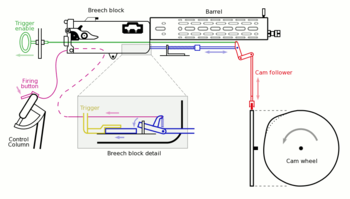
Diagram of Fokker's "Stangensteuerung" synchronisation mechanism. Pulling the dark-green handle drops the red cam follower onto the propeller shaft cam wheel. Twice during each rotation of the propeller the cam lifts the follower which depresses the bluish rod against the bound, connecting the yellow trigger plate to the purple firing push button allowing a round to exist fired.
The forward firing gun of a pusher "gun carrier" provided some offensive adequacy—the mounting of a auto gun firing to the rear from a ii-seater tractor shipping gave defensive capability. There was an obvious need for some ways to fire a machine gun forward from a tractor aircraft, especially from one of the small, lite, "watch" aircraft, adapted from pre-war racers, that were to perform most air gainsay duties for the rest of the war. It would seem most natural to place the gun between the airplane pilot and the propeller, firing in the direct line of flight and so that the gun could be aimed by "aiming the aircraft". It was too important that the breech of the weapon be readily attainable to the pilot so that he could clear the jams and stoppages to which early auto guns were decumbent. However, this presented an obvious problem: a percentage of bullets fired "gratuitous" through a revolving propeller will strike the blades, with predictable results. Early experiments with synchronised machine guns had been carried out in several countries earlier the war. Franz Schneider, then working for Nieuport in France but subsequently working for L.V.Yard. in Frg, patented a synchronisation gear on 15 July 1913. Early on Russian gear was designed past a Lieutenant Poplavko: the Edwards brothers in England designed the first British example, and the Morane-Saulnier company were also working on the problem in 1914. All these early experiments failed to attract official attending, partly due to official inertia and partly due to the failures of early synchronising gears, which included dangerously ricocheting bullets and disintegrating propellers.[14] The Lewis gun used on many Allied aircraft was virtually incommunicable to synchronise due to the erratic rate of burn due to its open bolt firing cycle. Some RNAS aircraft, including Bristol Scouts, had an unsynchronised fuselage-mounted Lewis gun positioned to fire directly through the propeller disk, nonetheless these were often not synchronized. Instead the prop blades were reinforced with tape to hold the wood together if hit, and information technology relied on the fact that the odds of any single round hitting a blade below 5%, so if short bursts were used, it offered a temporary expedient fifty-fifty if it was not an ideal solution.

A Morane-Saulnier's propeller with the "wedges" fitted.
The Proverb guns used by both the Allies (as the Vickers) and Federal republic of germany (as the Parabellum MG 14 and Spandau lMG 08) had a airtight bolt firing cycle that started with a bullet already in the breech and the breech closed, so the firing of the bullet was the next step in the bicycle. This meant that the exact instant the round would be fired could be more readily predicted, making these weapons considerably easier to synchronise. The standard French light machine gun, the Hotchkiss, was, like the Lewis, also unamenable to synchronisation. Poor quality control too hampered efforts, resulting in frequent "hang fire" rounds that didn't become off. The Morane-Saulnier company designed a "prophylactic backup" in the form of "deflector blades" (metallic wedges), fitted to the rear surfaces of a propeller at the radial bespeak where they could be struck past a bullet. Roland Garros used this system in a Morane-Saulnier Fifty in April 1915. He managed to score several kills, although the deflectors fell short of an platonic solution as the deflected rounds could yet cause damage. Engine failure eventually forced Garros to state backside enemy lines, and he and his secret weapon were captured by the Germans.[15] Famously, the German High Command passed Garros' captured Morane to the Fokker visitor—which already produced Morane type monoplanes for the German Air Service—with orders to copy the design. The deflector system was totally unsuitable for the steel-jacketed German armament so that the Fokker engineers were forced to revisit the synchronisation idea (perhaps infringing Schneider's patent), crafting the Stangensteuerung organisation past the spring of 1915, used on the examples of their pioneering Eindecker fighter. Crude as these niggling monoplanes were, they produced a period of High german air superiority, known equally the "Fokker Scourge" by the Allies. The psychological effect exceeded the fabric: The Allies had upwardly to now been more or less unchallenged in the air, and the vulnerability of their older reconnaissance shipping, specially the British B.E.2 and French Farman pushers, came as a very nasty shock.
Other methods [edit]

The actual Scout C, RFC series no. 1611, flown by Lanoe Hawker on 25 July 1915 in his Victoria Cross–earning appointment.
Another method used at this time to burn a machine gun forrad from a tractor blueprint was to mount the gun to fire above the propeller arc. This required the gun to be mounted on the top wing of biplanes and be mounted on complicated elevate-inducing structures in monoplanes. Reaching the gun then that drums or belts could be changed, or jams cleared, presented issues even when the gun could be mounted relatively close to the pilot. Eventually, Foster mounting became more than or less the standard way of mounting a Lewis gun in this position in the R.F.C.:[sixteen] this allowed the gun to slide backward for drum changing, and also to exist fired at an upward bending, a very effective mode of attacking an enemy from the "blind spot" under its tail. This type of mounting was nevertheless simply possible for a biplane with a acme wing positioned virtually the apex of the propeller's arc: It put considerable strain on the fragile wing structures of the menstruum, and information technology was less rigid than a gun mounting on the fuselage, producing a greater "scatter" of bullets, especially at anything just very short range.
The earliest versions of the Bristol Scout to see aerial combat duty in 1915, the Lookout C, had Lewis gun mounts in RNAS service that sometimes were elevated above the propeller arc, and sometimes (in an patently reckless fashion) firing directly through the propeller arc without synchronisation. During the spring and summer of 1915, Helm Lanoe Hawker of the Royal Flying Corps, however, had mounted his Lewis gun just forward of the cockpit to burn frontward and outwards, on the left side of his aircraft'south fuselage at about a 30° horizontal angle. On 25 July 1915 Captain Hawker flew his Watch C, bearing RFC serial number 1611 against several two-seat German observation aircraft of the Fliegertruppe, and managed to defeat three of them in aerial engagements to earn the first Victoria Cross awarded to a British fighter pilot, while engaged against enemy fixed-wing shipping.
1915: The Fokker Scourge [edit]

The actual aircraft that started the "Fokker Scourge", Leutnant Kurt Wintgens' Fokker M.5K/MG with IdFlieg military serial number "E.5/15", as it appeared at the time of Wintgens' pioneering engagement on i July 1915.
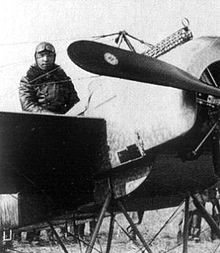
Max Immelmann of Feldflieger Abteilung 62 in the cockpit of his early production Fokker E.I. (s/n Due east.13/15).
The first purpose-designed fighter aircraft included the British Vickers F.B.five, and machine guns were also fitted to several French types, such as the Morane-Saulnier L and Due north. Initially the German Air Service lagged behind the Allies in this respect, but this was before long to modify dramatically.
In July 1915 the Fokker Due east.I, the first aircraft to enter service with a "synchronisation gear" which enabled a machine gun to fire through the arc of the propeller without striking its blades, became operational. This gave an important reward over other contemporary fighter aircraft. This aircraft and its immediate successors, collectively known equally the Eindecker (German for "monoplane") – for the offset time supplied an constructive equivalent to Allied fighters. 2 German military aviators, Leutnants Otto Parschau and Kurt Wintgens, worked for the Fokker business firm during the spring of 1915, demonstrating the revolutionary feature of the forward-firing synchronised machine gun to the embryonic force of Fliegertruppe pilots of the German Empire.
The kickoff successful engagement involving a synchronised-gun-armed aircraft occurred on the afternoon of July 1, 1915, to the east of Lunéville, France when Leutnant Kurt Wintgens, one of the pilots selected past Fokker to demonstrate the pocket-sized serial of v special Eindecker service-test prototype aircraft, forced down a French Morane-Saulnier "Parasol" two seat observation monoplane behind Allied lines with his Fokker Thousand.5K/MG Eindecker product image/service-examination aircraft, carrying the IdFlieg military serial number "E.5/xv". Some 200 shots from the synchronised Parabellum MG14 car gun on Wintgens' aircraft had striking the Gnome Lambda rotary engine of the Morane Parasol, forcing information technology to state safely in Centrolineal territory.[17]
By late 1915 the Germans had accomplished air superiority, rendering Centrolineal access to the vital intelligence derived from continual aeriform reconnaissance more unsafe to acquire. In particular the defencelessness of Allied reconnaissance types was exposed. The first High german "ace" pilots, notably Max Immelmann, had begun their careers.
The number of actual Allied casualties involved was for various reasons very small compared with the intensive air fighting of 1917–18. The deployment of the Eindeckers was less than overwhelming: the new blazon was issued in ones and twos to existing reconnaissance squadrons, and information technology was to be nearly a year earlier the Germans were to follow the British in establishing specialist fighter squadrons. The Eindecker was also, in spite of its advanced armament, by no ways an outstanding aircraft, being closely based on the pre-war Morane-Saulnier H, although it did feature a steel tubing fuselage framework (a characteristic of all Fokker wartime aircraft designs) instead of the wooden fuselage components of the French aircraft.
Nonetheless, the impact on morale of the fact that the Germans were effectively fighting back in the air created a major scandal in the British parliament and press. The ascendancy of the Eindecker also contributed to the surprise the Germans were able to achieve at the starting time of the Battle of Verdun because the French reconnaissance shipping failed to provide their usual cover of the German positions.
Fortunately for the Allies, two new British fighters that were a match for the Fokker, the ii-seat F.Due east.2b and the single-seat D.H.2, were already in production. These were both pushers, and could fire forwards without gun synchronisation. The F.Eastward.2b reached the forepart in September 1915, and the D.H.2 in the post-obit February. On the French front, the tiny Nieuport eleven, a tractor biplane with a forward firing gun mounted on the top fly outside the arc of the propeller, also proved more than than a match for the German fighter when information technology entered service in January 1916. With these new types the Allies re-established air superiority in time for the Battle of the Somme, and the "Fokker Scourge" was over.
The Fokker East.3, Airco DH-2 and Nieuport 11 were the very first in a long line of single seat fighter aircraft used past both sides during the war. Very apace it became clear the primary office of fighters would be attacking enemy two-seaters, which were condign increasingly important every bit sources of reconnaissance and arms observation, while also escorting and defending friendly two-seaters from enemy fighters. Fighters were also used to attack enemy ascertainment balloons, strafe enemy ground targets, and defend friendly airspace from enemy bombers.
Almost all the fighters in service with both sides, with the exception of the Fokkers' steel-tube fuselaged airframes, continued to use wood as the basic structural material, with material-covered wings relying on external wire bracing. However, the first practical all-metallic aircraft was produced by Hugo Junkers, who also used a cantilever wing structure with a metal covering. The kickoff flight tests of the initial flight demonstrator of this applied science, the Junkers J 1 monoplane, took place at the end of 1915 heralding the time to come of aircraft structural design.
1916: Verdun and the Somme [edit]
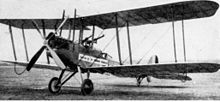
The ho-hum, all-too-stable B.E. 2c was yet in service in 1916, literally a "flying target" for German pilots.
Creating new units was easier than producing aircraft to equip them, and grooming pilots to man them. When the Battle of the Somme started in July 1916, nigh ordinary RFC squadrons were still equipped with planes that proved easy targets for the Fokker. New types such as the Sopwith ane½ Strutter had to be transferred from production intended for the RNAS. Fifty-fifty more seriously, replacement pilots were being sent to France with pitifully few flying hours.
Nonetheless, air superiority and an "offensive" strategy facilitated the greatly increased involvement of the RFC in the battle itself, in what was known at the fourth dimension every bit "trench strafing" – in modernistic terms, close back up. For the rest of the war, this became a regular routine, with both attacking and defending infantry in a country battle being constantly liable to set on past machine guns and light bombs from the air. At this time, counter fire from the ground was far less effective than it became later, when the necessary techniques of deflection shooting had been mastered.
The first step towards specialist fighter-merely aviation units within the German military was the establishment of the so-chosen Kampfeinsitzer Kommando (single-seat battle unit, abbreviated as "KEK") formations past Inspektor-Major Friedrich Stempel in Feb 1916. These were based around Eindeckers and other new fighter designs emerging, like the Pfalz Eastward-series monoplanes, that were being detached from their former Feldflieger Abteilung units during the winter of 1915–xvi and brought together in pairs and quartets at especially strategic locations, every bit "KEK" units were formed at Habsheim, Vaux, Avillers, Jametz, and Cunel, every bit well equally other strategic locations along the Western Front end to act as Luftwachtdienst (aeriform guard force) units, consisting just of fighters.[18] In a pioneering move in March 1916, German primary aerial tactician Oswald Boelcke came up with the idea of having "forward observers" located close to the front lines to spot Allied aircraft approaching the forepart, to avoid wear and tear on the trio of Fokker Eindecker watch aircraft he had based with his own "KEK" unit based at Sivry-sur-Meuse,[19] but north of Verdun. By Apr 1916, the air superiority established past the Eindecker pilots and maintained by their use inside the KEK formations had long evaporated every bit the Halberstadt D.II began to be phased in as Germany'south commencement biplane fighter design, with the first Fokker D-series biplane fighters joining the Halberstadts, and a target was prepare to constitute 37 new squadrons in the side by side 12 months – entirely equipped with single seat fighters, and manned by specially selected and trained pilots, to counter the Centrolineal fighter squadrons already experiencing considerable success, every bit operated by the Imperial Flying Corps and the French Aéronautique Militaire. The minor numbers of questionably built Fokker D.IIIs posted to the Front end pioneered the mounting of twin lMG 08s earlier 1916's terminate, as the building numbers of the similarly armed, and much more formidable new twin-gun Albatros D.Is were well on the way to establishing the German air superiority marker the first half of 1917.
Allied air superiority was maintained during the meridian of both battles, and the increased effectiveness of Centrolineal air activity proved disturbing to the German Regular army'south top-level Oberste Heeresleitung command staff.[xx] A complete reorganisation of the Fliegertruppen des deutschen Kaiserreiches into what became officially known as the Luftstreitkräfte followed and had generally been completed by October 1916. This reorganisation somewhen produced the High german strategic bombing squadrons that were to produce such consternation in England in 1917 and 1918, and the specialist close support squadrons (Schlachtstaffeln) that gave the British infantry such trouble at Cambrai and during the German spring offensive of 1918. Its most famous and dramatic upshot, however, involved the raising of specialist fighter squadrons or Jagdstaffeln – a full yr after similar units had get part of the RFC and the French Aéronautique Militaire. Initially these units were equipped with the Halberstadt D.II (Deutschland's showtime biplane fighter), the Fokker D.I and D.Two, along with the last few surviving Eindeckers, all three biplane design types using a single lMG 08, before the Fokker D.3 and Albatros D.I twin-gun types arrived at the Front.
1917: Encarmine Apr [edit]
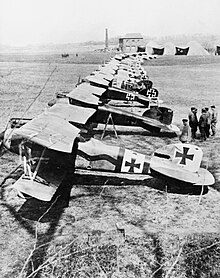
A lineup of Albatros D.IIIs of Jasta 11 in early 1917 – the second shipping in this lineup belonged to Manfred von Richthofen.
The get-go one-half of 1917 was a successful menstruation for the jagdstaffeln and the much larger RFC suffered significantly higher casualties than their opponents. While new Centrolineal fighters such equally the Sopwith Pup, Sopwith Triplane, and SPAD S.VII were coming into service, at this stage their numbers were small, and suffered from junior firepower: all 3 were armed with simply a single synchronised Vickers motorcar gun. On the other hand, the jagdstaffeln were in the process of replacing their early motley array of equipment with Albatros D-serial shipping, armed with twin synchronised MG08s. The D.I and D.2 of late 1916 were succeeded past the new Albatros D.III, which was, in spite of structural difficulties, "the best fighting spotter on the Western Forepart"[21] at the fourth dimension. Meanwhile, near RFC two-seater squadrons still flew the Exist.2e, a very pocket-sized improvement on the Exist.2c, and still fundamentally unsuited to air-to-air combat.
This culminated in the rout of April 1917, known as "Bloody April". The RFC suffered particularly severe losses, although Trenchard'due south policy of "offensive patrol", which placed about combat flying on the German side of the lines, was maintained.[22]
During the terminal half of 1917, the British Sopwith Camel and S.Due east.5a and the French SPAD Due south.Thirteen, all fitted with two forward firing machine guns, became available in numbers. The ordinary two seater squadrons in the RFC received the R.East.eight or the F.Yard.8, non outstanding warplanes, but far less vulnerable than the Exist.2e they replaced. The F.E.2d at last received a worthy replacement in the Bristol F.2b. On the other paw, the latest Albatros, the D.V, proved to be a thwarting, as was the Pfalz D.III. The exotic Fokker Dr.I was plagued, like the Albatros, with structural issues. By the terminate of the twelvemonth the air superiority pendulum had swung over again in the Allies' favour.
1918 – the Spring Offensive [edit]
The surrender of the Russians and the Treaty of Brest-Litovsk in March 1918, and the resulting release of troops from the Eastern Front gave the Germans a "final chance" of winning the war earlier the Americans could become effectively involved. This resulted in the concluding great High german offensive of the war, the "Spring Offensive", which opened on 21 March. The chief attack fell on the British forepart on the assumption that defeat of the British ground forces would result in the surrender of the mutiny-weakened French.[23]
In the air, the boxing was marked past the carefully coordinated use of the Schlachtstaffeln or "battle flights", equipped with the light CL class two seaters built by the Halberstadt and Hannover firms, that had proved so effective in the High german counter-attack in early October's Boxing of Cambrai.[24] The new German language fighter shipping, notably the Fokker D.VII, that might accept revived German air superiority in time for this boxing had non however reached the Jagdstaffeln in sufficient numbers, despite its own premier on the Western Front in the mid-Spring of 1918. As with several offensives on both sides, thorough planning and preparation led to initial success, and in fact to deeper penetration than had been achieved by either side since 1914.[25] Many British airfields had to be abandoned to the advancing Germans in a new war of movement. Losses of aircraft and their coiffure were very heavy on both sides – especially to lite anti-shipping fire. Notwithstanding, by the time of the death of Manfred von Richthofen, the famed Crimson Businesswoman, on 21 April, the great offensive had largely stalled.[26] The new German fighters had still not arrived, and the British still held general air superiority.
The calendar month of April 1918 began with the consolidation of the separate British RFC and RNAS air services into the Imperial Air Force, the kickoff independent air arm not subordinate to its national army or navy. By the end of April, the new Fokker, Pfalz and Roland fighters had finally begun to supplant the obsolescent equipment of the Jagdstaffeln, merely this did not proceed with as much dispatch every bit it might have, due to increasing shortages of supplies on the side of the Central Powers, and many of the Jastas still flew Albatros D types at the time of the ceasefire. The rotary engined Fokker D.VIII and Siemens-Schuckert D.4, also every bit surviving Fokker Triplanes, suffered from poor reliability and shortened engine life due to the Voltol-based oil that was used to replace deficient castor oil – captured and salvaged Centrolineal shipping (especially Sopwith Camels) were scrounged, not only for engines and equipment, simply even for their lubricants. Nonetheless, by September, casualties in the RFC had reached the highest level since "Bloody April"[27] – and the Allies were maintaining air superiority by weight of numbers rather than technical superiority.
Readying for boxing [edit]

Major General Mason Patrick was assigned Primary of the U.S. Air Service by General John J. Pershing in May 1918 to improve organization and production in the Air Service.
1918, especially the 2nd half of the year, also saw the Us increasingly involved with the allied aerial efforts. While American volunteers had been flying in Centrolineal squadrons since the early years of the state of war, not until 1918 did all-American squadrons begin active operations. Technically America had fallen well behind the European powers in aviation, and no American designed types saw action, with the exception of the Curtiss flight boats. At outset, the Americans were supplied with 2d-charge per unit and obsolete aircraft, such as the Sopwith one½ Strutter, Dorand AR and Sopwith Camel, and inexperienced American airmen stood little chance against their seasoned opponents.
Full general John J. Pershing assigned Major General Mason Patrick as Chief of the U.s. Air Service to remedy these issues in May 1918.[28] Every bit numbers grew and equipment improved with the introduction of the twin-gun Nieuport 28, and after, SPAD XIII as well as the S.Eastward.5a into American service most the war's end, the Americans came to concord their own in the air; although casualties were heavy, every bit indeed were those of the French and British, in the last desperate fighting of the war. I of the French twin-seat reconnaissance aircraft used past both the French and the USAAS, was the radial powered Salmson 2 A.2.
Leading upward to the Battle of Saint-Mihiel, The U.s.a. Air Service under Maj. Gen. Patrick oversaw the organization of 28 air squadrons for the battle, with the French, British, and Italians contributing boosted units to bring the full force numbers to 701 pursuit planes, 366 observation planes, 323 twenty-four hours bombers, and 91 dark bombers. The 1,481 total aircraft made information technology the largest air operation of the war.[29] [thirty]
Impact [edit]
The mean solar day has passed when armies on the basis or navies on the sea can be the arbiter of a nation's destiny in war. The primary power of defence force and the power of initiative against an enemy has passed to the air.
By war's end, the impact of aeriform missions on the basis state of war was in hindsight mainly tactical; strategic bombing, in particular, was yet very rudimentary indeed. This was partly due to its restricted funding and use, as information technology was, after all, a new technology. On the other paw, the artillery, which had perchance the greatest effect of any armed services arm in this war, was in very large part as devastating equally it was due to the availability of aeriform photography and aerial "spotting" by balloon and aircraft. By 1917 weather bad enough to restrict flying was considered as expert as "putting the gunner'south optics out".[32]
Some, such as then-Brigadier Full general Baton Mitchell, commander of all American air combat units in France, claimed, "[T]he only harm that has come to [Frg] has been through the air".[33] Mitchell was famously controversial in his view that the hereafter of war was not on the basis or at sea, but in the air.
During the course of the War, High german aircraft losses deemed to 27,637 by all causes, while Entente losses numbered over 88,613 lost (52,640 France & 35,973 Groovy U.k.).[ citation needed ]
Anti-aircraft weaponry [edit]

Though aircraft even so functioned equally vehicles of observation, increasingly they were used as a weapon in themselves. Domestic dog fights erupted in the skies over the front end lines, and shipping went downwardly in flames. From this air-to-air combat, the need grew for better shipping and gun ammunition. Aside from car guns, air-to-air rockets were also used, such equally the Le Prieur rocket against balloons and airships. Recoilless rifles and autocannons were also attempted, but they pushed early fighters to unsafe limits while bringing negligible returns, with the German language Becker 20mm autocannon existence fitted to a few twin-engined Luftstreitkräfte Thousand-serial medium bombers for offensive needs, and at least ane late-war Kaiserliche Marine zeppelin for defense – the uniquely armed SPAD Southward.XII single-seat fighter carried ane Vickers machine gun and a special, hand-operated semi-automatic 37mm gun firing through a hollow propeller shaft.[34] Another innovation was air-to-air bombing if a fighter had been fortunate enough to climb higher than an airship. The Ranken dart was designed just for this opportunity.
This need for comeback was not limited to air-to-air combat. On the ground, methods developed before the state of war were being used to deter enemy aircraft from ascertainment and bombing. Anti-aircraft artillery rounds were fired into the air and exploded into clouds of fume and fragmentation, called archie by the British.
Anti-shipping artillery defenses were increasingly used around observation balloons, which became frequent targets of enemy fighters equipped with special incendiary bullets. Because balloons were and so combustible, due to the hydrogen used to inflate them, observers were given parachutes, enabling them to jump to safety. Ironically, merely a few aircrew had this option, due in part to a mistaken belief they inhibited aggressiveness, and in part to their significant weight.
Kickoff shooting-down of an airplane by anti-aircraft artillery [edit]
During a bombing raid over Kragujevac on 30 September 1915, private Radoje Ljutovac of the Serbian Army successfully shot down 1 of the iii shipping. Ljutovac used a slightly modified Turkish cannon captured some years previously. This was the first time that a armed services plane was shot down with ground-to-air artillery burn down, and thus a crucial moment in anti-aircraft warfare.[35] [36] [37]
Bombing and reconnaissance [edit]
Video prune of allied bombing runs over German lines

Gotha G.V German bomber, 1917
Equally the stalemate adult on the ground, with both sides unable to advance even a few hundred yards without a major boxing and thousands of casualties, shipping became profoundly valued for their office gathering intelligence on enemy positions and bombing the enemy'south supplies behind the trench lines. Big aircraft with a pilot and an observer were used to scout enemy positions and bomb their supply bases. Considering they were large and deadening, these shipping made like shooting fish in a barrel targets for enemy fighter aircraft. As a effect, both sides used fighter shipping to both attack the enemy's 2-seat shipping and protect their ain while carrying out their missions.
While the ii-seat bombers and reconnaissance aircraft were tedious and vulnerable, they were not defenseless. Two-seaters had the reward of both forward- and rearward-firing guns. Typically, the pilot controlled fixed guns backside the propeller, like to guns in a fighter aircraft, while the observer controlled one with which he could cover the arc behind the aircraft. A tactic used past enemy fighter shipping to avoid burn down from the rear gunner was to assault from slightly below the rear of ii-seaters, every bit the tail gunner was unable to fire below the aircraft. Nevertheless, two-seaters could counter this tactic by going into a dive at high speeds. Pursuing a diving two-seater was hazardous for a fighter pilot, as it would identify the fighter directly in the rear gunner'south line of fire; several high scoring aces of the war were shot down by "lowly" 2-seaters, including Raoul Lufbery, Erwin Böhme, and Robert Little. Fifty-fifty Manfred von Richthofen, the highest scoring ace of WWI, was once wounded and forced to crash land from the bullets of a 2-seater, though he did survive the encounter and continued flying after he recovered.
Strategic bombing [edit]
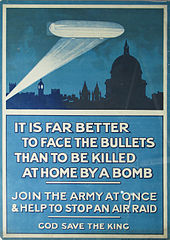
British recruiting poster capitalizing on the scare created past the bombing raids on London
The commencement aerial battery of civilians occurred during Earth War I. In the opening weeks of the war, zeppelins bombed Liège, Antwerp, and Warsaw, and other cities, including Paris and Bucharest, were targeted, In January 1915 the Germans began a bombing campaign against England that was to final until 1918, initially using airships. There were 19 raids in 1915, in which 37 tons of bombs were dropped, killing 181 people and injuring 455. Raids continued in 1916. London was accidentally bombed in May, and in July, the Kaiser immune directed raids against urban centres. There were 23 airship raids in 1916 in which 125 tons of ordnance were dropped, killing 293 people and injuring 691. Gradually British air defenses improved. In 1917 and 1918 there were simply xi Zeppelin raids against England, and the concluding raid occurred on 5 August 1918, resulting in the death of Peter Strasser, commander of the High german Naval Airship Department. Past the finish of the war, 54 airship raids had been undertaken, in which 557 people were killed and 1,358 injured.[38] Of the lxxx airships used by the Germans in World War I, 34 were shot downwards and further 33 were destroyed past accidents. 389 crewmen died.[39]
The Zeppelin raids were complemented by the Gotha G bombers from 1917, which were the starting time heavier than air bombers to be used for strategic bombing, and by a small force of five Zeppelin-Staaken R.Six "behemothic" iv engined bombers from late September 1917 through to mid-May 1918. Twenty-four Gotha twin-engined bombers were shot downward on the raids over England, with no losses for the Zeppelin-Staaken giants. Farther 37 Gotha bombers crashed in accidents.[39] They dropped 73 tons of bombs, killing 857 people and wounding 2058.[39]
Information technology has been argued that the raids were effective far across material damage in diverting and hampering wartime production, and diverting twelve squadrons and over 17,000 men to air defenses.[40] Calculations performed on the number of dead to the weight of bombs dropped had a profound effect on attitudes of the British authorities and population in the interwar years, who believed that "The bomber will e'er become through".
Observation balloons [edit]
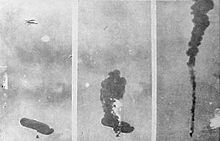
A German observation balloon existence shot down past an Centrolineal aircraft.
Manned ascertainment balloons floating high above the trenches were used equally stationary reconnaissance points on the front lines, reporting enemy troop positions and directing artillery fire. Balloons commonly had a coiffure of two equipped with parachutes: upon an enemy air set on on the flammable balloon, the crew would parachute to safety. Recognized for their value every bit observer platforms, observation balloons were important targets of enemy aircraft. To defend confronting air set on, they were heavily protected by large concentrations of antiaircraft guns and patrolled by friendly aircraft. Blimps and balloons helped contribute to the stalemate of the trench warfare of World War I, and contributed to air-to-air combat for air superiority because of their significant reconnaissance value.
To encourage pilots to attack enemy balloons, both sides counted downing an enemy airship equally an "air-to-air" kill, with the same value as shooting downwards an enemy aircraft. Some pilots, known every bit airship busters, became peculiarly distinguished by their prowess at shooting down enemy balloons. The premier airship busting ace was Willy Coppens: 35 of his 37 victories were enemy balloons.
Leading aces [edit]
Every bit pioneer aviators invented air-to-air gainsay, the contending sides developed various methods of tracking aerial casualties and victories. Aviators with 5 or more aerial victories confirmed by their parent air service were dubbed "aces". Their numbers would burgeon, until past war'southward cease, there were over 1,800 aces.
The following aces scored the well-nigh victories for their respective air services.
| Name | Air service | Confirmed victories |
|---|---|---|
| Baracca, Francesco | Corpo Aeronautico Militare | 34[41] |
| Bishop, William Avery | Imperial Air Forcefulness | 72[42] |
| Brumowski, Godwin | Luftfahrtruppen | 35[43] |
| Cobby, Arthur Henry | Australian Flight Corps | 29[ citation needed ] |
| Coppens de Houthulst, Willy Omer | Belgian Military Aviation | 37[44] |
| Fonck, René | Aéronautique Militaire | 75[45] |
| Kazakov, Alexander | Imperial Russian Air Force | twenty[46] |
| Richthofen, Manfred von | Luftstreitkräfte | 80[47] |
| Rickenbacker, Edward Vernon | US Ground forces Air Service | 26[48] [49] |
Pioneers of aeriform warfare [edit]
The post-obit aviators were the first to reach important milestones in the development of aerial combat during Earth War I:
| Name | Engagement | Country | Event |
|---|---|---|---|
| Miodrag Tomić | 12 August 1914 | Serbia | First dogfight of the war[l] [51] |
| Pyotr Nesterov | 7 September 1914 | Russia | First air-to-air kill, by ramming an Austrian aeroplane[52] |
| Louis Quénault and Joseph Frantz | 5 October 1914 | French republic | Airplane pilot Frantz and Observer Quénault were the first fliers to successfully employ a machine gun in air-to-air gainsay to shoot down some other shipping.[53] |
| Roland Garros | 1 April 1915 | France | First aerial victory with frontwards pointing fixed gun achieved while aiming gun with aircraft[54] |
| Adolphe Pégoud | 3 April 1915 | France | Outset flight "ace" and starting time French ace.[ commendation needed ] |
| Kurt Wintgens | 1 July 1915 | Germany | First aerial victory using a sychronised machine gun firing through the propeller arc[ citation needed ] |
| Lanoe Bell-ringer | 11 August 1915 | United kingdom of great britain and northern ireland | Commencement British ace.[ commendation needed ] |
| Oswald Boelcke | sixteen October 1915 | Germany | Get-go German ace.[ commendation needed ] |
| Otto Jindra | 9 April 1916 | Austria-hungary | First Austro-Hungarian ace.[ citation needed ] |
| Redford Henry Mulock | 21 May 1916 | Canada | First Canadian ace, besides every bit commencement Royal Naval Air Service ace.[ citation needed ] |
| Eduard Pulpe | 1 July 1916 | Russia | First Imperial Russian Air Force ace.[ commendation needed ] |
| Roderic Dallas | 9 July 1916 | Australia | First Australian ace.[ citation needed ] |
| Frederick Libby | 25 August 1916 | The states | Offset American ace.[ citation needed ] |
| Etienne Tsu | 26 September 1916 | France | Offset Chinese ace; French Strange Legion, Escadrille SPA.37.[55] [56] |
| Mario Stoppani | 31 October 1916 | Italy | First Italian ace.[ commendation needed ] |
| Fernand Jacquet | 1 February 1917 | Kingdom of belgium | First Belgian ace.[ commendation needed ] |
| Maurice Benjamin | 27 Apr 1917 | Southward Africa | First Southward African ace.[ commendation needed ] |
| Thomas Culling | 19 May 1917 | New Zealand | First New Zealand ace.[ commendation needed ] |
| Gottfried Freiherr von Banfield | 31 May 1917 | Austria-hungary | First night victory and first Austro-Hungarian night victory.[ citation needed ] |
| Dumitru Bădulescu | 21 September 1917 | Romania | First Romanaian ace.[57] |
| Richard Burnard Munday | 29 September 1917 | Great britain | Start British nighttime victory, over an observation balloon.[ citation needed ] |
| Fritz Anders | xx August 1918 | Germany | First German night victory. Anders was first night fighter ace.[ citation needed ] |
Shipping [edit]
- Aircraft of the Entente Powers
- Aircraft of the Central Powers
Come across also [edit]
- Biggles a fictional WWI aviator
- Biplane
- Dogfight
- Flight ace § World War I
- History of aerial warfare
- History of aviation
- List of American aero squadrons
- Listing of Royal Air Force shipping squadrons
- List of Royal Flight Corps squadrons
- Lists of World War I flying aces
Notes [edit]
- ^ Spaight, James (1914). Aircraft In War. London: MacMilian and Co. p. 3.
- ^ Spaight, James (1914). Aircraft in War. London: MacMilian and Co. p. 14.
- ^ Terraine, John. P.xxx
- ^ "Aerial Reconnaissance in Globe War I". U.S. Centennial of Flight Commission. Retrieved vi March 2014.
- ^ Terraine, 1981, p.31.
- ^ Terraine, 1981, p.xxx
- ^ Terraine, 1982, p.31
- ^ Treadwell, Terry C. America's First Air War (London: Airlife Publishing, 2000)
- ^ Cheesman, E.F. (ed.) Reconnaissance & Bomber Aircraft of the 1914–1918 War (Letchworth, United kingdom: Harleyford, 1962), p. 9.
- ^ a b c An Illustrated History of World War I, at http://www.wwiaviation.com/earlywar.html
- ^ Eric Lawson; Jane Lawson (2007). The First Air Campaign: August 1914 – November 1918. Da Capo Press, Incorporated. p. 123. ISBN978-0-306-81668-0.
- ^ Cracking Battles of World War I by Major-Full general Sir Jeremy Moore, p. 136
- ^ Cheesman (1960), p. 76.
- ^ Cheesman (1960), p 177
- ^ Cheesman (1960), p 178
- ^ Cheesman (1960), p 180
- ^ Sands, Jeffrey, "The Forgotten Ace, Ltn. Kurt Wintgens and his State of war Letters", Cross & Cockade United states of america, Summertime 1985.
- ^ Guttman, Jon (Summer 2009). "Verdun: The First Air Battle for the Fighter: Part I – Prelude and Opening" (PDF). worldwar1.com. The Great War Lodge. p. ix. Archived from the original (PDF) on June 3, 2016. Retrieved May 26, 2014.
- ^ vanWyngarden, Greg (2006). Osprey Aircraft of the Aces #73: Early High german Aces of Globe War 1. Botley, Oxford United kingdom of great britain and northern ireland & New York City, The states: Osprey Publishing. p. 35. ISBN978-ane-84176-997-4.
- ^ Cheesman (1960) p.12
- ^ Fitzsimons, Bernard, ed. The Twentieth Century Encyclopedia of Weapons and Warfare (London: Phoebus, 1978), Book 1, "Albatros D", p.65
- ^ Johnson in History of Air Fighting blames Trenchard for not changing his approach despite the prohibitive casualties.
- ^ Terraine, 1982 p. 277
- ^ Grayness & Theyford, 1970 pp. xv–xxvii
- ^ Terraine, 1982 p.282
- ^ Terraine, 1982 p.287
- ^ Harris & Pearson, 2010 p.180
- ^ Tate, Dr. James P. (1998). The Army and its Air Corps: Ground forces Policy Toward Aviation 1919–1941, Air University Press, p. 19
- ^ Frandsen, Bert (2014). "Learning and Adapting: Billy Mitchell in World War I". National Defense Academy Press . Retrieved July thirteen, 2019.
- ^ DuPre, Flint. "U.South. Air Force Biographical Dictionary". United States Air Strength . Retrieved July 12, 2019.
- ^ This quote was also mentioned in Time mag, 22 June 1942 [1], some 7 months after the Japanese bombing of Pearl Harbor, which Mitchell accurately predicted in 1924.
- ^ Terraine, 1982, p. 215
- ^ "Mitchell">"Leaves From My War Diary" past General William Mitchell, in Smashing Battles of Globe State of war I: In The Air (Signet, 1966), pp.192–193 (November 1918).
- ^ Guttman, Jon (2002). SPAD XII/Xiii aces of World War I. Osprey Publishing. pp. 8–9. ISBN1841763160.
- ^ "How was the first military machine aeroplane shot down". National Geographic. Retrieved five August 2015.
- ^ "Ljutovac, Radoje". Amanet Society. Archived from the original on half-dozen October 2014. Retrieved 5 August 2015.
- ^ "Radoje Raka Ljutovac – first person in the world to shoot down an plane with a cannon". Pečat. Retrieved 5 August 2015.
- ^ Cole, Christopher; Cheesman, Eastward. F. (1984). The Air Defence force of Britain 1914–1918. London: Putnam. pp. 448–nine. ISBN0 370 30538 eight.
- ^ a b c Clodfelter, Micheal (2017). Warfare and Armed Conflicts: A Statistical Encyclopedia of Casualty and Other Figures, 1492–2015. McFarland. p. 430.
- ^ Ben Walsh AQA GCSE Modern World History p296
- ^ Franks, 2000. p. 76
- ^ Shores, 2001. p. 89
- ^ Chant, 2002. p. 90
- ^ Franks, 2000. p. 71
- ^ Guttman, 2002. p. 20
- ^ Franks, 2000. pp. 83–84
- ^ Franks, Bailey, Guest, 1993. pp. 241–242
- ^ Franks, 2000. p. 74
- ^ Franks, 2001. p. 86
- ^ Glenny, Misha (2012). The Balkans: 1804–2012. New York City: Granta. p. 316. ISBN978-1-77089-273-6.
- ^ Buttar, Prit (2014). Collision of Empires: The War on the Eastern Front in 1914. Oxford, England: Osprey Publishing. p. 298. ISBN978-1-78200-648-0.
- ^ Guttman, p. nine.
- ^ Jackson 1993, p. 24
- ^ van Wyngarden, pp. seven, 8, 11.
- ^ "L'escadrille_37". Albindenis.gratuitous.fr. Retrieved 2015-12-17 .
- ^ Laurent BROCARD (1914-08-02). "Flying Pioneers : Vieilles Tiges". Past-to-present.com. Retrieved 2015-12-17 .
- ^ Valeriu Avram, Alexandru Armă (2018). Aeronautica română în Războiul de Întregire naţională 1916-1919 (in Romanian). Editura Vremea. p. 51.
{{cite book}}: CS1 maint: uses authors parameter (link)
References [edit]
- Editors of American Heritage. History of WW1. Simon & Schuster, 1964.
- Cheesman, E.F. (ed.) Fighter Aircraft of the 1914–1918 State of war. Letchworth, Great britain: Harleyford, 1960
- The Cracking War, television documentary past the BBC.
- Grey, Peter & Thetford, Owen German Aircraft of the First World State of war. London, Putnam, 1962.
- Guttman, Jon. Pusher Aces of World State of war 1: Volume 88 of Osprey Aircraft of the Aces: Volume 88 of Shipping of the Aces. Osprey Publishing, 2009. ISBN 1-84603-417-five, ISBN 978-1-84603-417-6
- Herris, Jack & Pearson, Bob Aircraft of World War I. London, Amber Books, 2010. ISBN 978-ane-906626-65-5.
- Jackson, Peter The Guinness Book of Air Warfare. London, Guinness Publishing, 1993. ISBN 0-85112-701-0
- Morrow, John. German language Air Power in World War I. Lincoln: Academy of Nebraska Press, 1982. Contains pattern and product figures, as well as economic influences.
- Pearson, George, Aces: A Story of the Get-go Air War, historical advice by Brereton Greenhous and Philip Markham, NFB, 1993. Contains assertion aircraft created trench stalemate.
- Terraine, John White Rut: the new warfare 1914–18. London, Social club Publishing, 1982
- VanWyngarden, Greg. Early German Aces of World War I: Book 73 of Aircraft of the Aces. Osprey Publishing, 2006. ISBN 1-84176-997-5, ISBN 978-1-84176-997-4.
- Winter, Denis. First of the Few. London: Allen Lane/Penguin, 1982. Coverage of the British air war, with extensive bibliographical notes.
External links [edit]
- Wells, Mark: Shipping, Fighter and Pursuit, in: 1914-1918-online. International Encyclopedia of the Starting time World War.
- Morris, Craig: Aircraft, Reconnaissance and Bomber, in: 1914-1918-online. International Encyclopedia of the First World War.
- Mahoney, Ross & Pugh, James: Air Warfare, in: 1914-1918-online. International Encyclopedia of the First Earth State of war.
- Bombing during Globe War I at centennialofflight.gov
- Boris Rustam-Bek-Tageev. Aerial Russian federation: The Romance of the Behemothic Aeroplane. Рипол Классик. ISBN978-5-87787-214-i.
- The United states of america Air Service in World War I – usaww1.com
- The League of Globe State of war I Aviation Historians and Over the Front Magazine – overthefront.com
- Offset World War in the Air at the Dictionary of Canadian Biography
- 1989 WWI aviation documentary featuring interviews with the last three surviving American aces – YouTube
gaskinauncesubled.blogspot.com
Source: https://en.wikipedia.org/wiki/Aviation_in_World_War_I
0 Response to "How to Draw Wwi Planes"
Post a Comment